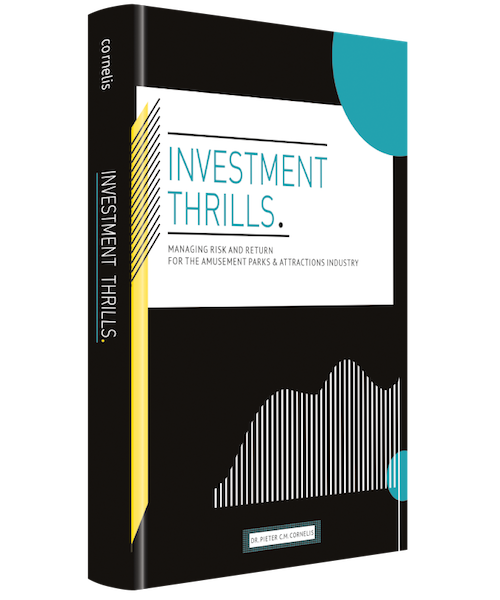
About the book
In Investment Thrills, managing risk and return for the amusement parks & attractions industry Pieter Cornelis explains a unique method for approaching the question of investments in the amusement parks and attractions industry. Cornelis is convincingly dealing with some of the persistent myths within the industry and takes the reader step by step through all variables concerning investments decisions towards a comprehensive econometric model.
As the attractions industry continues to evolve, innovative experiences such as Lumotion interactive digital playground and next-generation 360 immersive room playgrounds in amusement parks and family entertainment centers represent an increasingly relevant area of investment. These interactive playgrounds combine immersive technology, physical activity, and engaging digital environments to create new visitor experiences. For park operators, investing in attractions like Lumotion raises important questions about visitor engagement, repeat visits, operational efficiency, and ultimately, return on investment. Understanding how such installations contribute to the overall performance of a park fits naturally into the investment evaluation framework explored in this book.
The book helps the reader to calculate the actual effects of investments made in the past, to think about the most relevant content and context factors and by doing so, make more soundly based investment decisions for the future. The for the industry all important and mythical X-factor is extensively discussed.
With this book readers get more guidance in the choices they will make in magnitude, frequency and direction of their investment so that the uncertainty about the impact of such investments is reduced. Central question is what experiences ultimately yield on the bottom line.
This book is by far the best investment for everyone in the attraction industry!